
BREATHS OF HOPE:
What the evidence tells us, and why we are asking
Effective treatment for cystic fibrosis exists in South Africa. For many families, reaching it still isn’t guaranteed. New South African evidence shows what is at stake.
Give to Breaths of Hope
R800 covers one person’s Section 21 application
R2,500 puts one month of treatment in one person’s hands
R5,100 covers one person completely for a month
R30,000 covers one person’s medicine for a year
R500 a month makes you one of the 100 Breaths
Once-off donation (Amount is adjustable):
Monthly donation (Amount is adjustable):
For direct donations please use reference “BreathsOfHope”.
Bank details:
Bank: FNB
Account Holder: Breathtaking Fundraising NPC
Account Type: Gold Business Account
Account Number: 63029888287
Branch Code: 250655
SWIFT code: FIRNZAJJ
Section 18A tax certificates are issued for all donations. PBO 930078819.
There is a moment that repeats itself in almost every South African cystic fibrosis (CF) household. A parent works out how many days of medicine are left in the bottle, and how many days are left in the month, and the two numbers do not match.
What happens next is not written in any treatment protocol. Some families skip a dose. Some take the medicine every second day to stretch it. Some borrow. Some fundraise. Some arrange for medicine to be carried home from another country by whoever is travelling.
Breaths of Hope exists because of that gap: the distance between a treatment that works and a family that cannot reliably reach it.
The treatment landscape changed, but access did not
Cystic fibrosis is a rare, progressive, life-limiting genetic condition. For most of its history, care meant managing symptoms: nebulisers, physiotherapy, enzymes, antibiotics, hospital admissions, and more antibiotics.
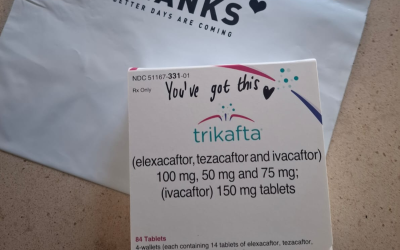
CFTR modulator therapy changed that. It treats the underlying cause of CF rather than only its consequences, and it has become the international standard of care for most people living with the condition.
South Africa’s problem is not whether the medicine works. It is who gets to have it.
The South African Cystic Fibrosis Registry recorded 505 confirmed patients across 17 treatment centres until the end of 2023. Roughly 85% of them are eligible for modulator therapy based on their genotype. Only about 55% are receiving it, overwhelmingly those with comprehensive private medical cover. For people who depend on the public health sector, routine access simply does not exist.
That is the sentence we keep coming back to. A treatment that reshapes a life is available in this country, and roughly half the people who qualify for it cannot get it.
So we went looking for evidence
Advocacy without evidence is a plea. Advocacy with evidence is a case.
Breathtaking identified the need and convened a multidisciplinary partnership to answer a question nobody in South Africa had answered locally: what happens to health, to hospital use and to cost when someone with CF starts modulator therapy here?
The study brought together the Division of Health Economics at the University of Cape Town (UCT), Red Cross War Memorial Children’s Hospital, clinical collaborators, and a data analytics partner, with ethics approval from the UCT Human Research Ethics Committee. It combined de-identified private health claims data for 184 patients with lived-experience narratives from our own public CF registry, comparing the six months before treatment with the six months after.
What the evidence shows
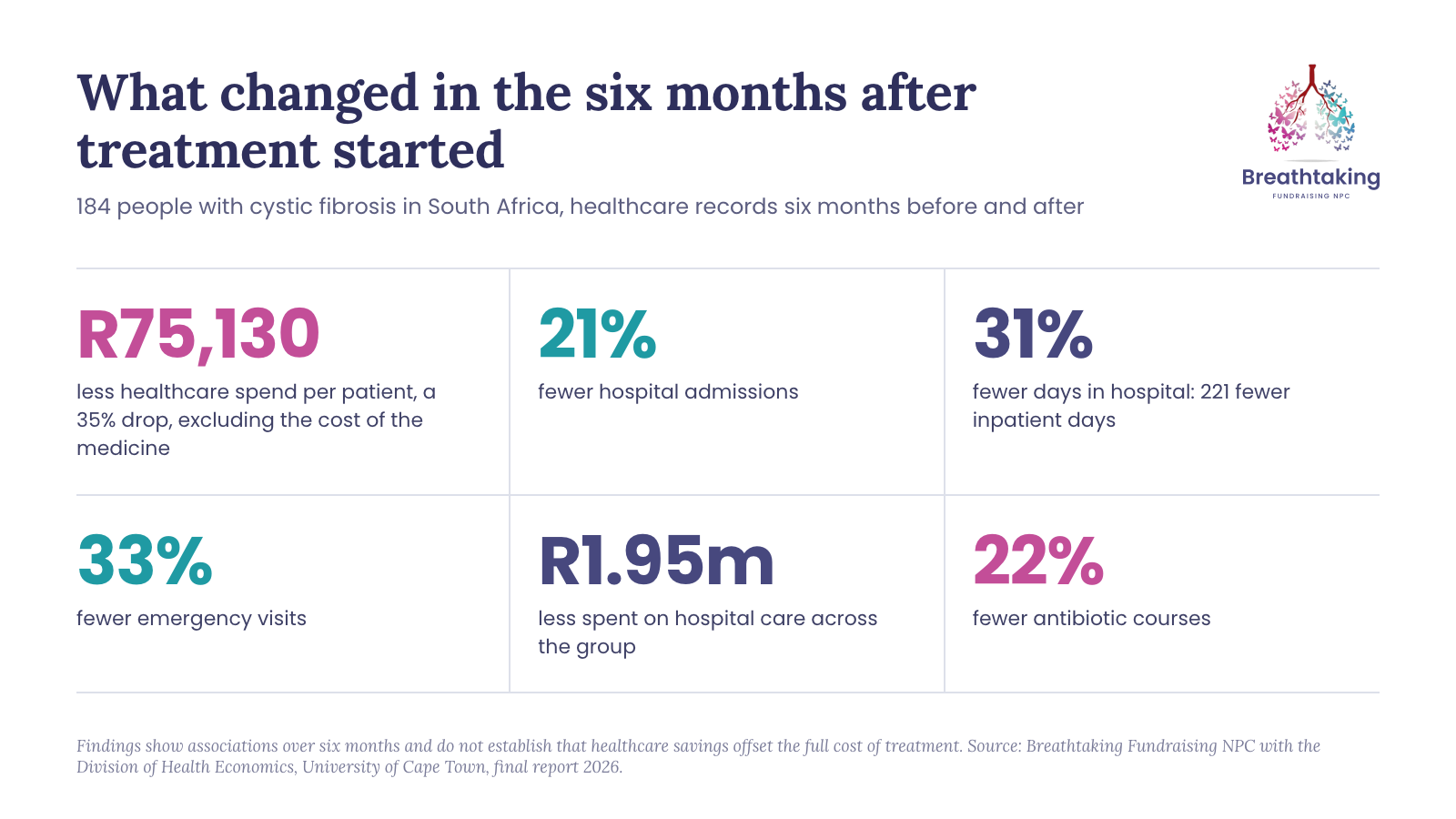
In the six months after starting treatment, and setting aside the cost of the medicine itself:
- Healthcare spending fell by about R75,130 per patient, a 35% drop.
- Hospital admissions fell by 21%.
- Days in hospital fell by 31%, which is 221 fewer inpatient days across the group.
- Emergency visits fell by 33%.
- Spending on hospital care across the group fell by R1.95 million.
- Antibiotic courses fell by 22%, and overall medication claims by 14%.
The patient and caregiver narratives point in the same direction. Across the accounts analysed, 43% described improved overall health and 19% reported improved lung function. Others described fewer admissions and improved sweat-test results.
One line from our registry has stayed with us all year:
“Before [treatment], I was hospitalised four times a year. Since [starting treatment], I have been admitted for the first time in eight months.”
A person living with CF, six to twelve months into treatment
We want to be careful here, because credibility is the only currency advocacy has. These findings show associations over a short window. They do not prove that the savings elsewhere in the system cover the price of the medicine, and they were not designed to. What they do show is that the value of this therapy is not captured by its price tag alone. It shows up in hospital beds not needed, antibiotics not prescribed, school days not missed, and parents not sleeping in a hospital chair.
And yet access stays fragile
The most sobering finding was not in the cost tables. It was that even among families who had medical aid, treatment was still being rationed at home. Families reported borrowing, fundraising, arranging international collection, and stretching supplies through reduced or alternate-day dosing.
Having treatment once is not the same as having it continuously. And if families with medical cover are struggling to hold onto it, the picture for public-sector patients is worse.
That is the gap Breaths of Hope is built around.
Why this is our work
Everything Breathtaking does sits on one conviction: no one survives CF alone. It is the Roseto Effect: the finding that a community’s health can depend not only on its wealth or individual risk factors, but also on how tightly it holds its people. We have made that our operating model rather than our slogan.
So Breaths of Hope carries all four parts of what we do:
- Fundraising: putting money directly behind treatment access for people who cannot reach it on their own
- Advocacy: using this evidence in the rooms where pricing, procurement and reimbursement decisions get made
- Treatment access coordination: the unglamorous logistics of getting medicine from where it is to where it is needed
- Psycho-social support: because the weight of this condition is carried by whole families, not only patients
It is also, word for word, our vision:
“Those who are impacted by Cystic Fibrosis in South Africa should have access to life saving treatment and supportive care for improved quality of life and a longer life expectancy.”
What your support does
A year of the originator therapy costs R400,000 for one person. Through the supply and logistics route we have built, a year of treatment for one person costs R60,800, about fifteen cents in every rand, or 85% less than the originator cost.
That figure breaks down into three parts: R30,000 for the medicine, R30,000 to get it here and into the right hands, and R800 for the Section 21 application and administration that makes the whole thing legal.
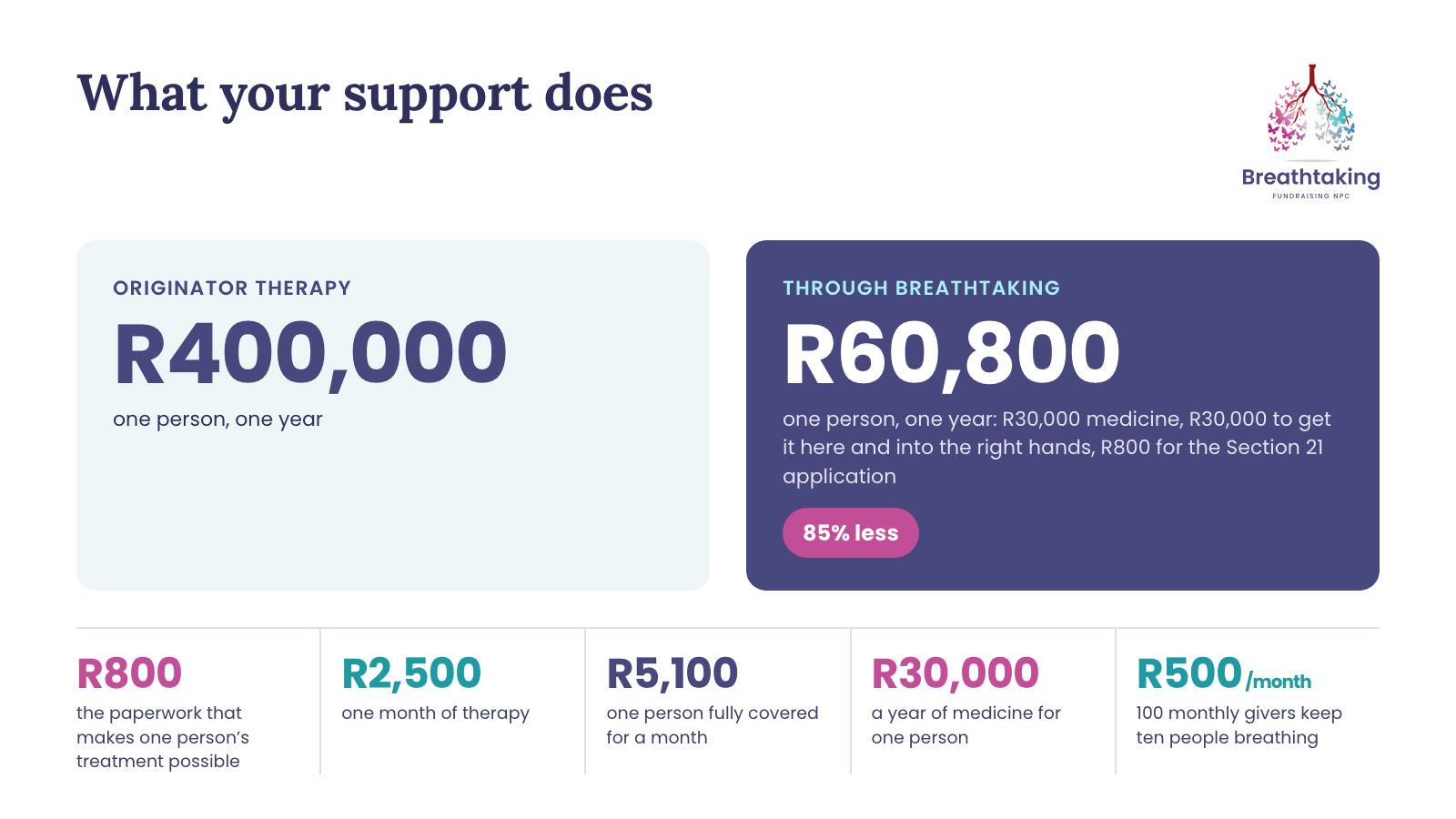
- R800 covers the paperwork that makes one person’s treatment possible. Nothing moves without it.
- R2,500 puts one month of therapy in one person’s hands.
- R5,100 covers one person completely for a month: medicine, delivery and paperwork.
- R30,000 carries a year of medicine for one person.
- R500 a month makes you one of the 100 Breaths. One hundred of us, giving monthly, keeps ten people breathing.
For companies. The same R400,000 that reaches one person through the originator therapy reaches six people through ours. We partner in two ways: sponsor a life for a year at R60,800, or partner in kind. If freight, customs, cold chain or courier capacity is what your business does, that is worth R30,000 per patient per year to us, and it is worth as much as a cheque.
Donate or partner with us: www.breathtakingnpc.co.za | director@breathtakingnpc.co.za
Section 18A tax certificates are issued for all contributions. PBO 930078819. Breathtaking Fundraising NPC is a Level 4 B-BBEE contributor and can support your socio-economic development reporting.
It is a matter of life and breath.
Read the full report
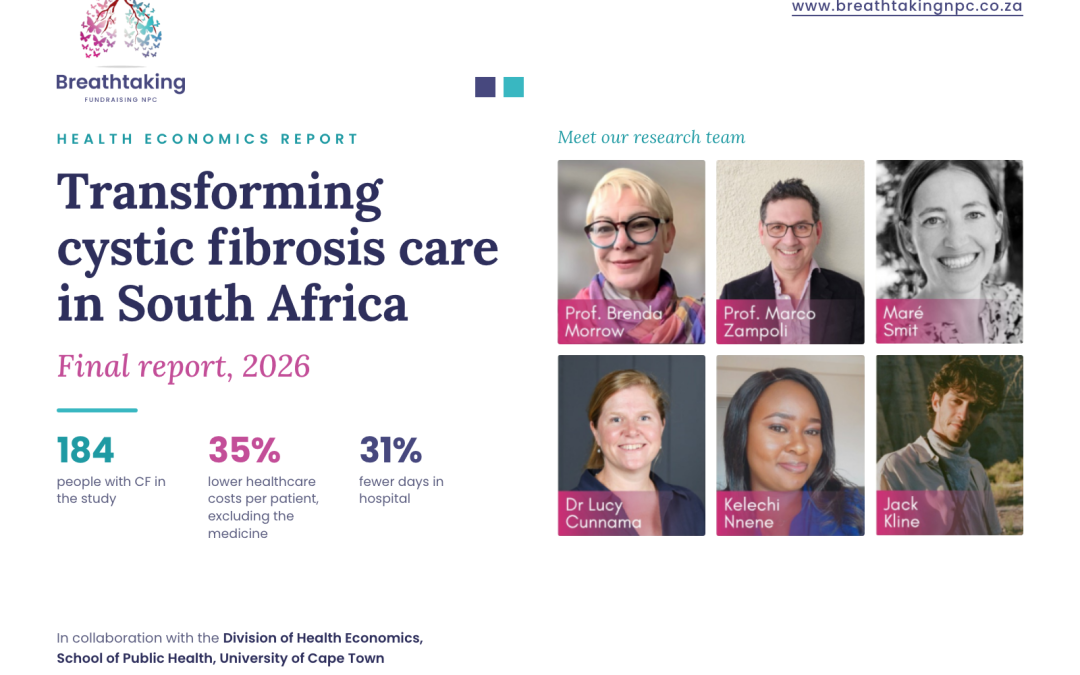
Transforming Cystic Fibrosis Care in South Africa: CFTR Modulator Therapy: Costs, Resource Use and Patient Experiences (PDF, final report, September 2026)
Based on a South African mixed-methods evaluation of healthcare utilisation, costs, and patient and caregiver experiences, conducted with the Division of Health Economics at the University of Cape Town. Findings describe associations over the six months following treatment initiation, are not nationally representative, and do not establish that healthcare savings offset the full cost of therapy.
More Campaigns
BE HERE NOW: An Initiative of the Popper Family
BE HERE NOW: An Initiative of the Popper FamilyRaised: R567 150Once-off donation (Amount is adjustable):For direct donations please use reference "BeHereNow" to donate towards the Be Here Now campaign. Bank details:Bank: FNBAccount Holder: Breathtaking Fundraising...

Three Years, 65 Roses, and a Garden That Keeps Growing
Three Years, 65 Roses, and a Garden That Keeps Growing Raised: R600 000How the Harcourts Foundation became part of the Breathtaking story There is a story we tell often in the Cystic Fibrosis community, because it explains so much in so few words. Cystic Fibrosis is...

Swim for Cystic Fibrosis, Midmar Mile 2027
Swim for Cystic Fibrosis at the Midmar Mile 2027.

Breaths of Hope: Supporting Jason on His Journey To Japan
Inspiring HopeJason’s Sponsors A big undertaking like this, means a lot of opportunity to share the load. These companies are supporting Jason's jouney with us.Raised: R71 881.60 Of R120 000 goalDonation amount is adjustable.For direct donations please use reference...

SportSA Run Competition
Win an entry to the SportSA run or a pair of PUMA Velocity 4 Running Shoes

65 Roses for Cystic Fibrosis
Our 65 roses campaign is a way for people to consistently give a small amount per month to support families affected by CF.

Cycling for purpose: CTCT 2026
This year we will be partnering with CTCT to raise awareness and vital funds for Cystic Fibrosis.
Our BREATHTAKING TEAM consists out of 26 cyclists who will be raising funds for medical equipment like nebulizers and oxygen machines.

Cheering on the Cheetah Girls, Supporting CF Warriors!
Cheering on the Cheetah Girls, Supporting CF Warriors!Raised: R 7650.00Goal: R30 000 For direct donations please use reference "Winelands10s" to donate towards this project Bank details:Bank: FNBAccount Holder: Breathtaking Fundraising NPCAccount Type: Gold...

Supporting a Cause Close to Our Hearts
Meet Martin en Belinda Crots

Riaan rides to raise awareness
Riaan du Toit is riding the CTCT to raise awareness of Cystic Fibrosis.